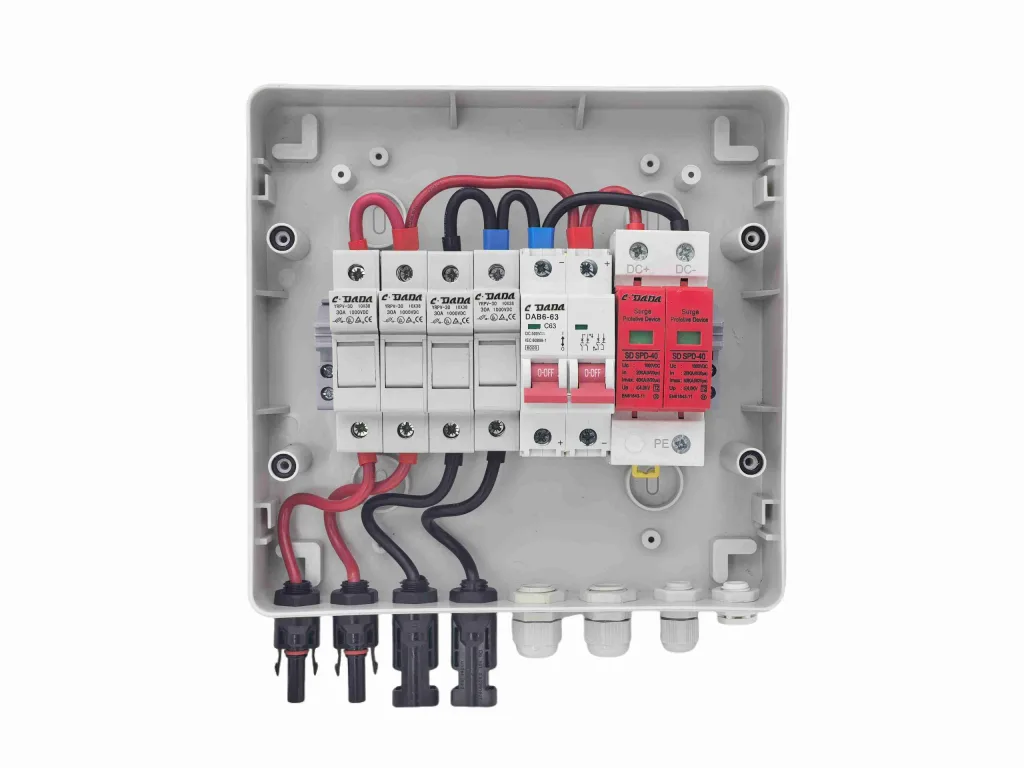
Introduction
In modern electrical systems, safety and reliability are paramount. One of the key components ensuring electrical safety is the Miniature Circuit Breaker (MCB), a device designed to protect circuits from overloads and short circuits. At Shanghai Dada Electric Co., Ltd., we specialize in high-quality MCBs that meet industry standards, ensuring optimal performance and safety for residential, commercial, and industrial applications.
This article provides a comprehensive guide on how to select the right MCB, covering its definition, functions, advantages, and key selection criteria.
A Miniature Circuit Breaker (MCB) is an automatically operated electrical switch designed to protect an electrical circuit from damage caused by overcurrent (overload or short circuit). Unlike fuses, which need replacement after a fault, MCBs can be manually or automatically reset, making them a more efficient and cost-effective solution.
MCBs are widely used in low-voltage electrical systems (typically up to 1,000V) and are essential in:
– Residential buildings(homes, apartments)
– Commercial spaces (offices, retail stores)
– Industrial facilities (factories, warehouses)
MCBs serve three primary functions:
When a circuit draws more current than its rated capacity for an extended period, it can overheat and damage wiring or appliances. An MCB detects this overload and trips, cutting off the power to prevent damage.
A short circuit occurs when a live wire comes into direct contact with a neutral or ground wire, causing a sudden surge in current. MCBs react within milliseconds to interrupt the circuit, preventing fires or equipment failure.
MCBs also function as manual switches, allowing users to safely disconnect power for maintenance or emergencies.
Compared to traditional fuses, MCBs offer several benefits:
| Feature | MCB | Fuse |
| Resettable | Yes | No (must be replaced) |
| Response Time | Fast (milliseconds) | Fast, but one-time use |
| Precision | Adjustable tripping | Fixed tripping |
| Cost-Effectiveness | Long-term savings | Frequent replacement needed |
| Safety | Prevents fire hazards | May fail if wrong rating is used |
Why Choose MCBs?
– Enhanced safety – Prevents electrical fires and equipment damage.
– Convenience – No need for replacements; simply reset after tripping.
– Durability– Designed for repeated use without degradation.
– Better performance – Accurate tripping based on current conditions.
At Shanghai Dada Electric Co., Ltd., our MCBs are rigorously tested to ensure compliance with IEC 60898, GB 10963, and other international standards.
Choosing the correct MCB involves evaluating several key factors:
The current rating (measured in Amperes, A) indicates the maximum current the MCB can handle without tripping under normal conditions.
– For lighting circuits: 6A – 10A
– For sockets and appliances: 16A – 20A
– For heavy-duty equipment (e.g., air conditioners): 25A – 32A
Example: A 16A MCB is suitable for standard home sockets, while a 32A MCB may be needed for industrial machinery.
The breaking capacity is the maximum fault current an MCB can interrupt without damage.
– Standard residential use: 6 kA (kiloamperes)
– Commercial/industrial use: 10 kA or higher
Tip: In areas with high fault currents, select an MCB with a higher breaking capacity.
MCBs have different tripping curves based on their sensitivity to inrush currents:
| Curve Type | Application | Tripping Behavior |
| B Curve | Residential
(lighting, electronics) |
Trips at 3-5 times rated current |
| C Curve | General-purpose
(motors, transformers) |
Trips at 5-10 times rated current |
| D Curve | Industrial
(high inrush currents) |
Trips at 10-20 times rated current |
Example: A C-curve MCB is ideal for refrigerators and air conditioners, while a D-curve MCB is better for heavy machinery.
MCBs come in different pole configurations:
– Single Pole (1P): For single-phase circuits (e.g., lighting).
– Double Pole (2P): For complete circuit isolation (phase + neutral).
– Three Pole (3P): For three-phase systems (industrial use).
– Four Pole (4P): For three-phase + neutral applications.
Ensure the MCB meets international and local standards, such as:
– IEC 60898 (residential/commercial)
– EC 60947-2 (industrial)
– GB 10963(China standard)
Shanghai Dada Electric’s MCBs are certified for global safety and performance.
Avoid these errors to ensure optimal protection:
❌ Using the wrong current rating → Can cause nuisance tripping or failure to trip.
❌ Ignoring the tripping curve → May lead to unnecessary power cuts or delayed protection.
❌Overlooking environmental conditions → High temperatures or humidity may affect performance.
❌ Choosing a low breaking capacity → The MCB may fail during a high fault current.
Selecting the right Miniature Circuit Breaker (MCB) is crucial for electrical safety and efficiency. By considering factors such as current rating, breaking capacity, tripping curve, and number of poles, you can ensure optimal protection for your electrical system.
At Shanghai Dada Electric Co., Ltd., we provide high-quality, reliable MCBs tailored to various applications. Whether for home, office, or industrial use, our products meet the highest safety standards.
For expert advice on selecting the best MCB for your needs, **contact our team today!**
📞 Phone: +8615167477792
🌐 Website: www.dadamccb.com
✉Email: charlotte.weng@cdada.com
Protect your circuits with confidence—choose Shanghai Dada Electric!


 0086-15167477792
 charlotte.weng@cdada.com

No.171 Yezhuang Road, Zhuanghang, Fengxian, Shanghai, China