Direct current circuit breakers protect solar photovoltaic systems from overloads and short circuits. Choosing the right dc breakers for solar requires evaluating system voltage, operating current, breaking capacity, and installation conditions.
Because DC current does not naturally cross zero like AC current, solar DC breakers need suitable arc interruption methods to safely clear faults. Proper selection helps reduce equipment damage and supports reliable long term system operation.
Direct current circuits present unique protection challenges because DC current does not naturally cross zero during normal operation.
AC current periodically passes through zero, which helps interrupt an electrical arc. DC current maintains a continuous current path, so DC breakers require dedicated arc interruption methods.
When a fault occurs in a solar array, the resulting DC arc can continue through ionized air, generating intense heat that may damage breaker contacts and connected equipment.
To manage this sustained arc risk, specialized direct current protective devices feature engineered internal arc control mechanisms. These internal components isolate and stretch the direct current arc, driving it into dedicated quenching chambers.
The arc is quickly lengthened, cooled, and interrupted before the current path can cause permanent electrical damage. Installing standard alternating current protection devices on the direct current side of a solar array leads to uncontained arcing, localized overheating, and equipment failure during fault events.

Solar PV systems can combine circuit protection with other solar power electrical devices designed for different protection and control requirements across continuous high voltage solar applications.
Sizing protection equipment correctly requires evaluating the physical arc behavior alongside precise mathematical calculations.
Accurately sizing direct current circuit breakers requires more than checking nominal equipment ratings. Engineers should evaluate open circuit voltage, short circuit current, rated operating voltage, rated current, breaking capacity, and ambient temperature.
Solar panel voltage can increase in cold conditions, while temporary irradiance changes can affect current output. These factors should be included when determining the appropriate breaker ratings.
In PV sizing based on the NEC, designers apply the relevant continuous current and PV source circuit requirements to determine conductor and overcurrent protection ratings. Requirements vary by local standards and system configuration.
Designers should also consider continuous duty, irradiance conditions, and ambient temperature when selecting current and voltage ratings.
If the applicable PV calculation results in a 15.6A minimum protection requirement, a 16A breaker may be considered when conductor ampacity, equipment specifications, breaker characteristics, and applicable codes support the selection. Selecting suitable DC circuit breakers helps maintain appropriate circuit protection under expected operating conditions.
Once the electrical requirements are defined, the appropriate breaker series can be selected.
| Solar application | DADA series | Key specification or feature |
| Compact DC circuits | DAB7 63 | Miniature DC circuit breaker |
| PV circuits below 125A | DAB6 | Rated DC voltage up to 1000V |
| Main distribution applications | DAM3PV | MCCB for DC and photovoltaic applications |
Deciding on the correct protective device depends on total operating current, breaking capacity requirements, and physical system topology. Utilizing DAB6 DC photovoltaic circuit breakers provides dedicated protection for circuits with rated currents below 125A and rated DC voltages up to 1000V.
These units feature standard 35mm DIN rail installation profiles. These breakers can also be equipped with accessories such as auxiliary contacts, alarm contacts, and shunt releases for different control and monitoring requirements.
For localized subcircuits and compact line protection, the DAB7 63 DC miniature circuit breaker delivers dependable overload protection and short circuit protection. Its compact format makes it suitable for localized DC line protection where installation space is limited.
For commercial solar systems and main DC distribution applications, molded case circuit breakers provide a robust format for protecting main power circuits.
Deploying the DAM3 PV series moulded case circuit breaker supplies the structural strength necessary to protect DC power grid circuits and solar photovoltaic main distribution networks feeding central conversion equipment.
Even properly rated breakers can fail if installation practices ignore critical physical parameters such as wiring polarity and operating temperatures.
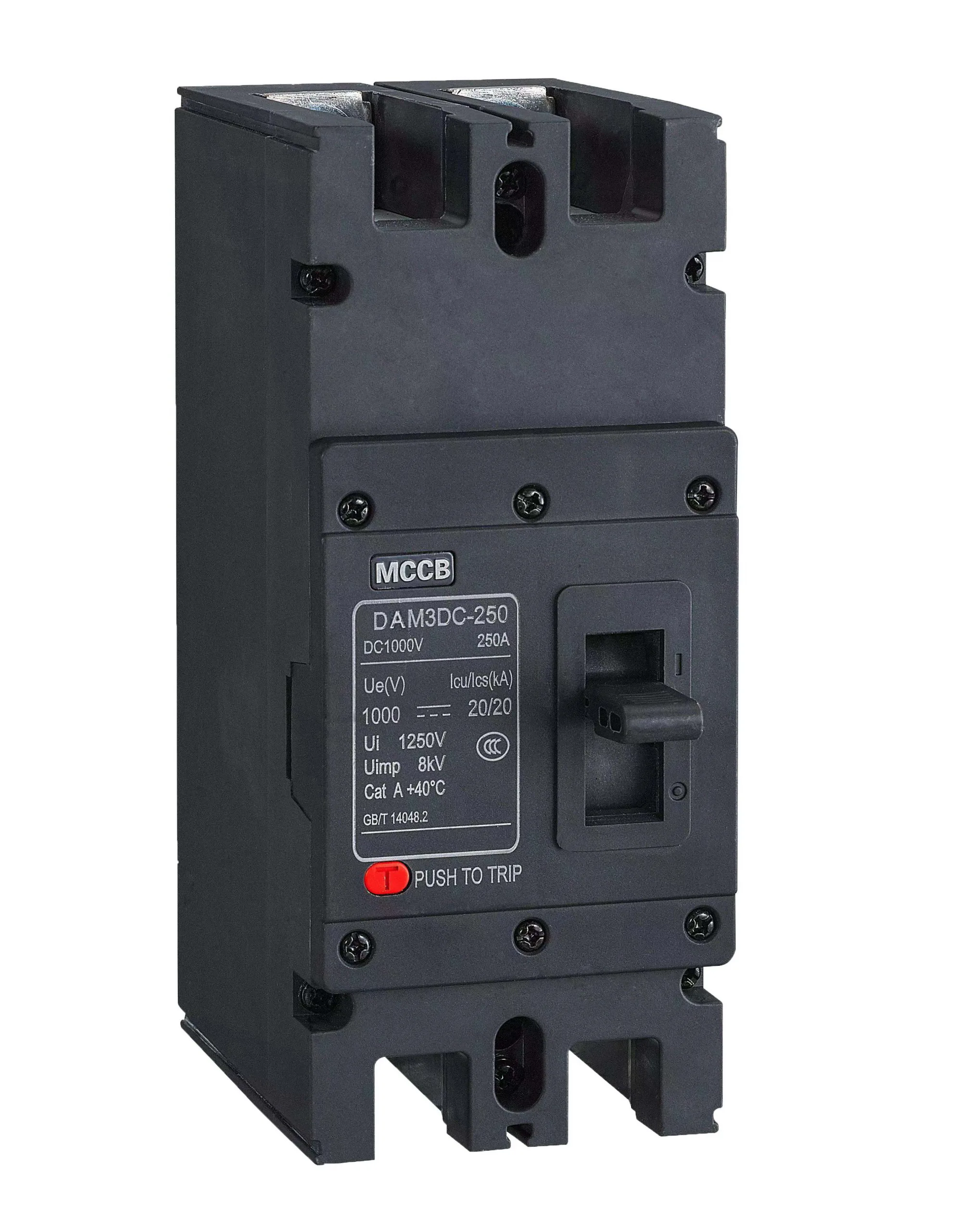
For polarized DC breakers, installation polarity must follow the manufacturer’s specified connection direction. Installers should check the positive and negative terminal markings before wiring and energizing the system.
Incorrect polarity can affect arc interruption performance during a fault. Following the specified wiring direction helps maintain proper breaker operation.
High ambient temperatures inside outdoor enclosures can affect breaker thermal performance. A PV combiner box exposed to direct sunlight may reach higher internal temperatures than the surrounding environment.
Designers should check the manufacturer’s derating curves and installation conditions instead of applying a fixed derating value. Adequate spacing and heat dissipation should also be considered around the DC inverter.
Breaker selection is only part of the protection design. Solar PV systems may also require surge protection.
For commercial and utility solar projects, buyers should assess factory capacity, production equipment, and quality control capabilities.
DADA Electric operates manufacturing facilities covering more than 50,000 square meters, with over 100 sets of main processing machines. The company also reports more than 500 projects annually and more than 70 technology invention patents.
Product certifications and quality systems help buyers evaluate compliance with project and market requirements.
The manufacturer maintains an ISO9001 quality management system and lists CE, CB, CCC, KEMA, ASTA, SEMKO, and ROHS among its certifications and compliance credentials.
For customized solar protection solutions, buyers should also consider R&D and technical support capabilities. The company reports more than 42 years of OEM and ODM experience, with 6 senior engineers, 15 research and design personnel, 9 senior technicians, and 28 intermediate technicians supporting product development and customization.
A DC breaker uses dedicated arc interruption methods because DC current does not naturally cross zero like AC current. This makes DC fault interruption more demanding.
A solar DC breaker should have a rated operating voltage that meets or exceeds the maximum calculated PV circuit voltage. For example, the DAB6 is rated for DC circuits up to 1000V.
Choose the breaker current rating based on the calculated PV circuit current, conductor ampacity, applicable code requirements, and installation conditions. Ambient temperature should also be considered when selecting the final rating.
Choosing the right DC breaker for a solar PV system requires evaluating voltage, current, breaking capacity, polarity, and installation conditions. Proper sizing and installation help reduce fault risks and support reliable operation.
For solar PV projects, Shanghai DADA Electric provides DC circuit breakers with OEM and ODM support. Contact the engineering team to discuss your project requirements and protection needs.

 0086-15167477792
 charlotte.weng@cdada.com

No.171 Yezhuang Road, Zhuanghang, Fengxian, Shanghai, China


